

How we built a client a chatbot that actually knows their material.
A client came to us with a problem I have run into in a lot of places. They run an assessment program. Over the years that program has generated a pile of material: the instrument itself, supporting documentation, and pretty detailed guidance on what to do next depending on what your results look like.
None of it was missing. That was the problem. Staff and users were both spending real time hunting through documents for answers those documents already contained. Finding the right page had turned into its own skill.
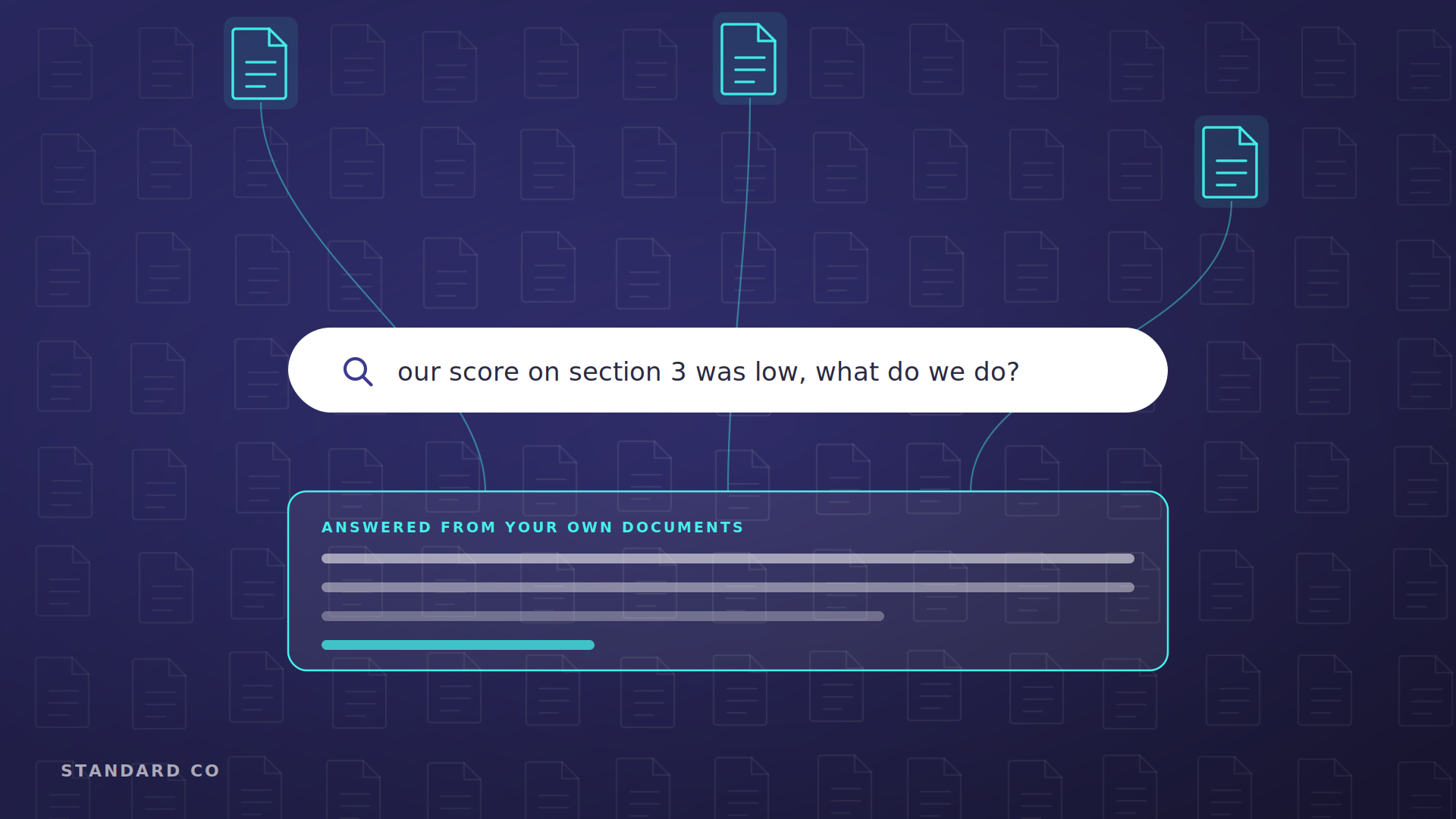
What they wanted was easy to say and annoying to build. Ask a normal question, like our score on section 3 was low, what do we do, and get an answer that comes from their own material.
Fair question. We asked it first. NotebookLM or a custom GPT gets you a version of this in an afternoon.
Three reasons we did not:
If none of those matter to you, use the off-the-shelf tool. Be honest with yourself about that before you start building anything.
Three pieces.
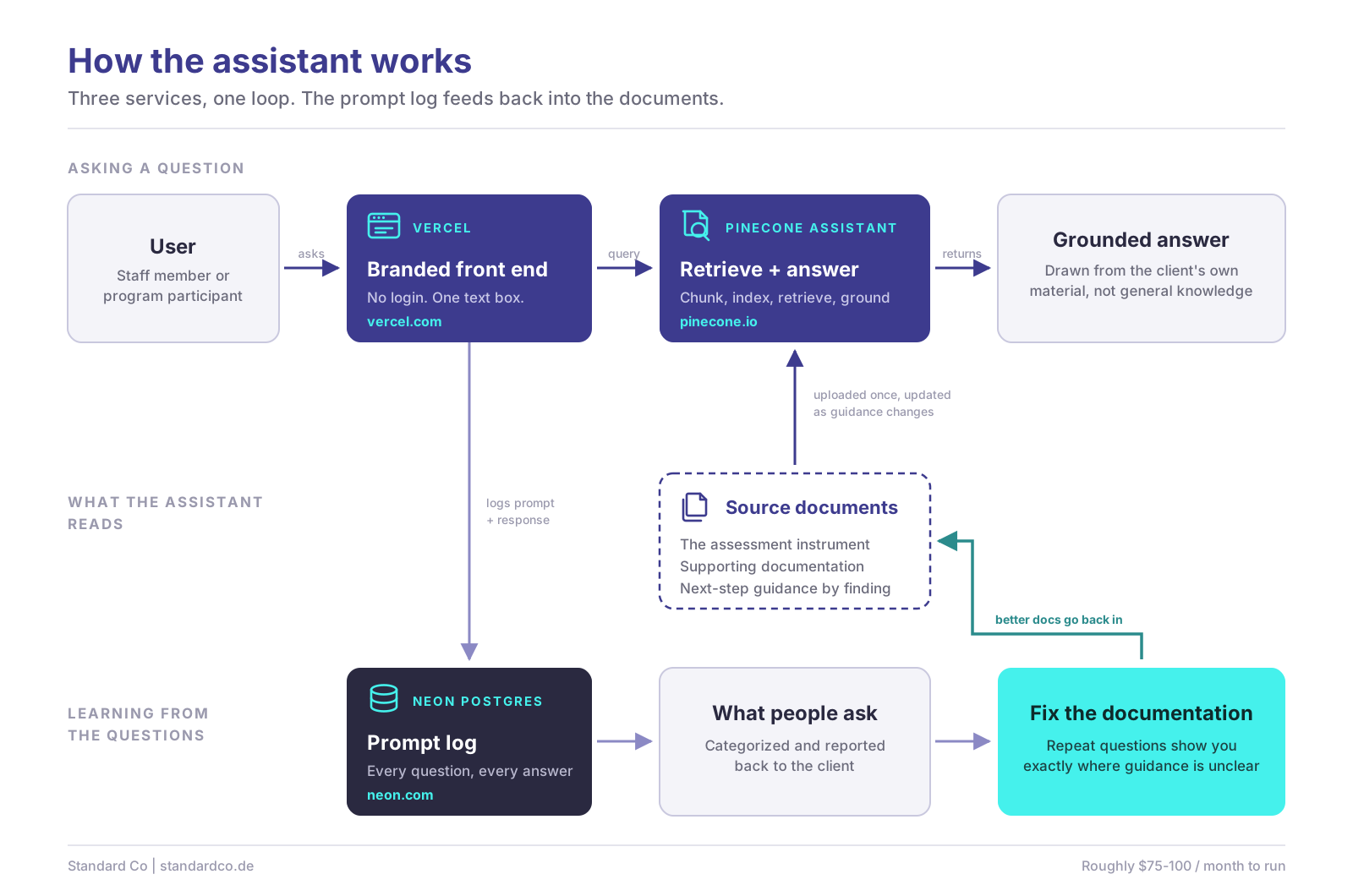
Pinecone Assistant does the heavy lifting. You upload the source documents and it handles chunking, indexing, retrieval, and generating an answer grounded in what it pulled back. That grounding is the whole ballgame. It is the difference between a chatbot that knows your material and one that improvises around it.
A front end on Vercel gives people a simple, branded place to type a question.
Neon, a serverless Postgres database, stores every prompt and every response. That log is ours, not buried in a vendor dashboard, which means we can categorize the questions and show the client what people are struggling with. Read it for a month and it stops being a log and starts being a list of where the documentation is unclear.
No retrieval system is perfect, and a tool that gives guidance based on assessment findings should be treated accordingly.
Two things help. The assistant answers from the loaded documents rather than from general knowledge, which cuts down on invented answers. And because we log every prompt and response, we can see when we need more guardrails or a source document we forgot to load.
You can prototype all three services on their free tiers. You cannot run a client deployment on them.
Vercel Hobby is non-commercial only, and their definition of commercial is broad enough to cover a consultant getting paid to write the code, so Pro at $20 a month is the floor for real work. Pinecone free Starter caps Assistant at 100 documents and 1.5 million input tokens a month, which a serious document set will blow through. Their Standard plan carries a $50 a month minimum. Neon free tier is genuinely fine at this scale.
Call it $75 to $100 a month to run, plus the build. For something that replaces hours of document-hunting every week, that math gets easy fast.
If you want to try it: open accounts on all three, load your documents into Pinecone Assistant, and wire up a simple front end. AI coding tools make the front end and the database plumbing far less work than they were two years ago.
The hard parts have not changed, and they are where these projects stall. Deciding which documents belong in the index. Keeping them current when the guidance changes. Actually reading the prompt logs closely enough to learn something from them.
That is the part we are good at. If you would rather not build it yourself, we will walk you through the setup, or run it for you.
Often, yes. If you do not need a branded page of your own, do not care about seeing the question history, and are fine with per-seat pricing, an off-the-shelf tool gets you most of the way in an afternoon. We built custom because this client needed all three: a front door they own, a log of every question asked, and a flat monthly cost.
Roughly $75 to $100 a month for the three services, plus the one-time build. That is Vercel Pro at $20 a month, a $50 a month minimum on Pinecone Standard, and Neon free tier, which is genuinely sufficient at this scale.
For a prototype, yes. For a client deployment, no. Vercel Hobby is non-commercial only and their definition of commercial covers a paid consultant writing the code. Pinecone free Starter caps Assistant at 100 documents and 1.5 million input tokens a month, which a real document set will exceed.
No. Pinecone Assistant handles chunking, embedding, indexing and retrieval for you, so you upload documents and query them. We use Neon for the prompt log, not for vectors.
Grounding. Pinecone Assistant answers from the documents you loaded rather than from general knowledge, so it is much less likely to invent something. It is not a guarantee, which is why we log every prompt and response and review them for missing guardrails and missing source documents.
No. The front end is a branded page with a single text box and no login. Not making people sign up somewhere else was one of the main reasons we did not use an off-the-shelf tool.
Not the code. It is deciding which documents belong in the index, keeping them current when the underlying guidance changes, and actually reading the prompt logs closely enough to learn something from them.
Because it turns into a list of where your documentation is unclear. Read a month of questions and the repeats show you exactly which guidance people cannot find or cannot follow. For this client that has been about as valuable as the chatbot itself.
151 Ted Turner Drive, Atlanta, GA
Let's talk: info@standardco.de